Friday, February 27, 2009

Essay On An Article Entitled, "I'm Not A Doctor, But I Play One On TV"

“I’m Not A Doctor, But I Play One On TV.”

First of all, I remember the line from the TV ad which it came from. Robert Young, a former movie star, had become a fixture on TV, first on the show “Father Knows Best,” and then on “Marcus Welby, MD,” where he played the senior doctor of a medical office. Two things were going on here; first, Bayer Aspirin’s advertising agency recognized that the value of a well known movie and TV star’s image would catch viewers attention, and second, advertising agencies have long known that the image of a person in a white lab coat with a stethoscope around his neck means to the viewer that this person knows something about what he’s talking about-even though he may, in reality, be just an actor. The quote from Robert Young went a tiny bit of a way toward correcting that.

What it means in this context, and why I picked up on it, is that in my own mind I am not identified as an employee of some corporation, although that is how things may appear at the time. I put that mantle on when I go to work dressed in a uniform. 7-Eleven, Fred Meyer, and McDonald’s (to name a few) want the public to see me that way, and that is why I put on the frock or the apron. I become 7-ELEVEN CLERK in their eyes, and they know that they can come to me at any time to ask a question about a certain product in the store. And for eight hours that is what I try to be.

But that is not who I am.

One of the points of this article is that it asks, “What does it mean that we so often turn to our jobs as definitive expressions of who and what we are?” I don’t think that is quite how it works. Our jobs do not define us; they are something that we shoehorn ourselves into to make a living. An actual career, on the other hand, may just touch on who we are, if we are lucky enough to get into one that fits us like a glove. Robert Young defined himself as an actor, not a doctor. Steve Jobs is happy being a CEO of a large corporation. Florence Nightingale was probably very proud of her accomplishments as a nurse. Ray Bradbury smiles a broad smile when you refer to him as an author of many books.

If being a 7-Eleven Clerk means to you, my customer, that I am someone who cares enough about you to give you the best service you have ever received, then I am happy. But if your image of a 7-Eleven clerk is someone like Apu the convenience store clerk on "The Simpsons" (a negative stereotype), and that is how you perceive me, by association, then I have a problem with that. That is a danger of the job, being associated with a negative stereotype. Believe me, when I go home, I get out of uniform as fast as possible, and start doing things which really are me, like reading books, watching movies, listening to music, building model cars, and writing. These are the part of me that the job doesn’t allow to come through. Being a 7-Eleven clerk, therefore, doesn’t define me, particularly when I consider myself an artist.

Now, I am going back to college in order to get myself a career that I will enjoy. Hopefully it will be something in the field of writing, and then I can say to you “That is what I am; a writer.” Now that would make me happy!

Tuesday, February 24, 2009

The Four Deadly Sins of Literary and Artistic Criticism


Roger Ebert, film critic:
Criticism is a destructive activity. If I like something and
the critics didn't, they can't see what's right there before their eyes because
they're in love with some theory. They don't have feelings; they have systems.
They think they know better than creators. They praise what they would have
done, instead of what an artist has done. They use foreign words to show off.
They're terrified of being exposed as the empty poseurs they are. They are
leeches on the skin of art.

I have often entertained the idea of becoming a film critic; not because I think I know more about movies than anyone else, but because there are so many critics (not just in film, but in other areas too) that are doing such a bad job of it. The challenge is to be as fair as possible; something that many critics don’t seem to know how to be.

When I was studying Drama in college, one of the things that I was taught was the definition of what critiquing is in its purest form: a reflection back to the artist of the effect that his work has on his audience. Criticism is the measuring stick by which the artist can judge whether the audience has received his work the way that he intended them to; did they enjoy it, or did they hate it? Did they learn what they were supposed to learn from it, or did they fall asleep during the first act? And if they didn’t get the message, what can the artist do to improve his work so that he will reach his audience more effectively?

Also, criticism has a simpler (but equally important) purpose: informing the rest of the audience about the piece, letting them know whether they will be interested in it or not, and maybe educating them about what it is trying to achieve along the way.

All this is important to the success of whatever piece (be it a book, a painting, a song, a play, or any other such media) the artist has created, and as a result, the critic is a necessary evil in the mix.

But all too often the critic trips and lands in deadly pitfalls that alienate him not only from the artist, but from the audience which he serves as a kind of conduit to, whether he knows he is doing it or not. There was one critic who, in my mind, exemplifies harmfully bad criticism at its worst. I was acting in a community theater in Southern California at the time, and this critic was well known in the area for attending plays, falling asleep during the performance, and then going home later and writing a review that would blast the show. Whether the show was really good or bad is irrelevant; that kind of review can do a great deal of unnecessary hurt and damage. I knew a lot of actors who were tempted to focus on him when they were on stage delivering their lines to him, in order to publicly embarrass him.

His is an extreme example, but many other critics do just as much damage by allowing themselves to fall into certain traps that are just as deadly.

These are what I would consider “sins” to be avoided, but which occur all too frequently: 1.) Becoming jaded as a critic. This is the worst offense; the number one sin. Many a good piece of work has been overlooked because a critic, who is suffering overload, has panned it. Still, one can see how it happens: a critic’s job is to review books, films, music, etc., day in and day out. This means that he must wade through a multitude of offerings, ranging from mediocre to bad, to get to the cream which rises above all the rest.

Unfortunately, to the audience, this means that a piece that they might enjoy gets slammed by the critic, and as a result the piece does not reach its’ audience. Let’s say that the classic Roddy McDowell movie Lassie Come Home has just been released to a present day audience (rather than in 1943, when it came out). Although it might be the movie which you would call your favorite movie of all time, even though your eyes mist over when Lassie runs into Roddy’s arms, and your three-year-old child is in tears for the doggie as she struggles to find her way home to her young master, the film critic (I guarantee this) will pan this as trite and overly sentimental. This is because these buttons have been pushed one too many times for the reviewer, and he has built up a conditioned response to this.

Many movies that are now called classics have been victimized by this kind of thinking. Butch Cassidy and the Sundance Kid surprisingly was one such movie. It was panned by the critics when it came out, but is now considered a western classic. Clint Eastwood, in his early years, was troubled by this kind of criticism. Whereas in hindsight many reviewers now appreciate as classics a trio of movies which he starred in that are part of a sub-genre commonly referred to as “spaghetti westerns” (A Fistful of Dollars, For a Few Dollars More, and The Good, the Bad, and the Ugly), they called his performances “wooden” at the time, the pictures themselves were dismissed as too violent, and were judged too vulgar and cheap in production style. There were several reasons for this; primarily Clint came out of television at a time when the medium was looked down on, and Italian movies were often made very cheaply, and therefore the quality was sometimes very poor. When they showed these “spaghetti westerns” (and Clint’s pictures were no exception) in the United States, the dubbing from Italian into English was poor, and the sound quality suffered immeasurably. Furthermore, the censorship that Hollywood had did not govern Italian films, and an action sequence in a “spaghetti western” would often include an actor shooting another actor with his gun in the same shot, which Hollywood could not do, and which, therefore, shocked many critics’ sensibilities. Lastly, Clint had chosen to emulate the older Hollywood stars (like James Cagney and Humphrey Bogart) in his performances, pointing out to Sergio Leone (the director) that these stars often said little, letting their actions tell the story; at which point he then threw out pages of dialogue that Leone had written for him to say. Brilliant as this choice was, it pushed one of these many buttons with the critics, who weren’t ready to see something new come out of Italy, or a TV star. Therefore Clint’s performances were spat upon, and the movies were trashed in the reviews. Fortunately for Clint, a younger audience got the message of what he was trying to do, and he shot to superstardom.

Sometimes it is easy to overlook gems when searching through the rubble.

2.) Snobbery pt. 1: Sneering at the artist. This almost goes hand in hand with being jaded as a major sin. I am not talking about disliking a piece of work because it is badly performed or because it seems dumb. This, after all, is what criticism is all about; reflecting the work back to the artist and letting him or her know how the work effects you. What I am speaking of is the type of reviewer who takes a derisive view of the work in question. For an example, I refer you to Stephen King who once said that he could tell a review was going to be bad because in the first line it would talk about how much money he had made. I am not a fan of Mr. King, but he really doesn’t deserve that kind of criticism. No artist does; simply because all art, even the worst trash, takes a certain amount of hard work to bring it to fruition.

So when you sneer at the artist you do not provide the reflection that he needs; you insult him, and everyone who worked with him to bring the project about. But you also do something worse: you offend, and risk, if you do it often enough, losing your audience. I can’t tell you how often I have been turned off to a critic who took a superior attitude towards the work he was reviewing. In such a review the sarcasm is so evident that it seems to literally drip off the page it is written on. I recently read an article in Rolling Stone magazine, about the Rock group Led Zeppelin, in which I was reminded of a review, that appeared in an issue from the early 70's, of the album Led Zeppelin II by critic John Mendelssohn that he wrote with just that kind of attitude. He said in his review (a sort of sequel to his review of their first album): “Hey, man, I take it all back! This is one f----ing heavyweight of an album! OK - I’ll concede that until you’ve listened to this album eight hundred times, as I have, it seems as if it’s just one heavy song extended over the space of two whole sides.” Did his review turn me off to the album? No, but it turned me off to him, and if Rolling Stone had published more of the same they would have lost me as a reader. (In a recent issue he states that his opinion hasn’t changed over the years, and that “I like melody, wit, vocal harmony, and expressiveness, all of which are lacking from Led Zeppelin.” One wonders what he makes of masters of avant garde classical music Charles Ives and John Cage who purposely lack some of those things too.)

It is interesting to study the classic film 2001: A Space Odyssey in this light. Because Stanley Kubrick chose to film this movie as an entirely visual experience, he invited a divisiveness among the viewing audience; you either loved it or hated it -there was no middle of the road. Even so, the reaction of the New York film critics was quite interesting; most of them dismissed the film as being made for eight year old minds. Amazing! Many adults hated it because they could not get what it was about, college kids across America were going back to see the film eight or nine times because they did not understand it, one student did a masters thesis on it which was commended by Kubrick because of how well she did understand what he was trying to say, and the New York film critics were condemning it as childish! Somewhere along the way someone lost touch with the public, and reality. (It is interesting to note that congressmen in Washington D.C., after seeing the movie, had the same reaction as the critics. Goes to show you.)

Lesson number 1: Be careful how you review the piece of work because you may be reviewing the audience for it as well.

Which brings me to the next point:

3.) Snobbery pt. 2: Sneering at the audience. Roger Ebert , bless him, chastised one critic that he had on as a guest (in his search to replace the late Gene Siskel for the show Siskel & Ebert At The Movies) for putting down the audience of a certain movie. Roger was right, in my opinion, to do so, because the critic had just offended a sizable part of his audience, whether he knew it or not. The audience of any piece of work is the bread and butter not only of the artist, but the critic as well, because the audience is going to turn to him to see what he thinks.

An extremely good example of what I am talking about is how many critics reacted to the movies of David and Jerry Zucker, and Jim Abrahams; mainly Airplane! and The Naked Gun. In the case of the film Airplane! (which was compared favorably to Mad Magazine satires), it was widely reported (and I experienced this myself) that you could literally walk into the theater it was showing at, and be greeted by a wall of laughter coming from the audience. No film before or since (with the exception of the Naked Gun movies) has ever had such a raucous outpouring of laughter, at least that I’m aware of. Yet many critics, in their reviews, declared the movie unfunny! I remember wondering if, when they were watching it, they were embarrassed to find themselves the only ones who were not rolling around in the aisles with laughter.

What is indicated here is a feeling of superiority towards other members of the audience. It particularly rears its ugly head when the subject is comedy, which has for centuries been the object of debates which this snobbery monster feeds off of. Comedy, according to experts, has been divided into two levels: high comedy and low comedy. Low comedy, sometimes called low-brow comedy, is, very simply, physical comedy; it is humor derived from all the pratfalls and missteps which occur to us in our everyday life. The slipping on a banana peel gag is often cited as an excellent example of this comedy. High comedy, or high-brow comedy, is defined as more intellectually challenging comedy; it often consists of irony, satire, word-play, and situational comedy. An example of this kind of comedy is the scene, occurring in many plays, where a woman is visiting a man in his room, finds herself in danger of being compromised when another caller, usually another woman, arrives at the front door, and therefore must hide in the closet, or under a bed or table in order not to be seen. (Oscar Wilde used that type of scene beautifully in the play An Ideal Husband.)

The debate over these two levels of comedy can be quite polarizing. At times in history high-cultured people would not be caught dead seeing a play that had references to bodily functions and pratfalls in it, for fear of being compromised like the woman in our little scene. The snobbery of critics who sneer at the other audience members is, to a certain extent, born out of this.

One critic, in his review of The Naked Gun, went so far as to review the audience who were present, putting them down as low intellects for enjoying the movie. This, to me, is uncalled for: aside from being rude to those who were enjoying the film, he told me virtually nothing about the movie by wasting ink on that particular subject, and insulted my intelligence by making me wade through his snobbishness to get to the rest of the review.

Now, mind you, commenting on audience reaction has its place, and is quite essential, in fact, to the future existence of any art form. The artist needs to know who the audience is, and what they want. And reviewing audience reaction on a cultural scale is a major and necessary function of criticism. For example the critic might ask; “Because the audience is more accepting of things that they wouldn’t have been before, is our culture headed to a decline and fall like the Roman Empire?” Recently, horror movies with their continually escalating quantities of violence and gore have often been the subjects of this kind of discussion by no less than critics like Roger Ebert and Michael Medved. But they are discussions, put forth in a form in which the reader or listener can take in each argument and decide for himself how he feels about it. In no case has the critic taken an arrogant point of view and sneered at the people who are, in fact, his own audience.

Remember, no one likes a smart ass.

4.) Limited knowledge of subject. My mother, who was a journalism major in college, once told me that at a newspaper the job of Drama Critic, rather than being assigned to someone with theater experience, often goes to whoever is in the room, so to speak. (I think that our sleeping critic probably got his job that way.) To be fair, I believe that this is more likely to happen at a small town paper than at a big city one. Sometimes, however, one has to wonder.

I remember reading a critic in San Diego who, in a capsule review of 2001: A Space Odyssey, made the statement that he did not think the special effects in that movie were very good, and that he had seen better effects in episodes of the Star Trek TV show, and certain TV commercials. In making that statement, it seemed to me that he showed his complete lack of knowledge about what a special effect is. The term “special effects” refers to the process by which an idea is brought to the screen in such a way that the audience is convinced that it is real. There are two kinds of effects in movie making: physical effects (such as explosions, winds, waves, scale modeling, anything that can be done “in camera” as they say), and visual effects, which entails using special photographic tricks to create a believable idea on the screen. 2001 was a film which took a great leap forward in presenting visual effects which had never been seen on the screen before. It artfully brought the idea of deep space to the screen in an incredibly realistic way. This was done by photographing separate elements such as a planet, a spacecraft and a star field and compositing them into a single frame of film. When run through a projector, the resulting image appears as real to the audience.

At the time which I read this review, 1978, the original Star Wars had been out for one year. Although it represented another giant leap in visual effects technology, it confused people about what that technology was. The elements in that film were not only space ships, planets, and star fields, but also laser beams and explosions. Many people assumed that visual effects technology was about how much of this kind of excitement you could throw upon the screen, not the process with which it was created. This, I suspect, is what the reviewer was relating too when he compared 2001 to Star Trek and those TV commercials. (It must be understood that Star Trek was a TV show with a relatively small budget, and therefore had a limited amount of money to spend on visual effects, which had to play on screens that were a lot smaller than we have now. The quality, as good as it was at the time, suffered accordingly when compared with what could be done on the big screen with a lot more money.)

So, what this means here, is the critic did not know what he was talking about. There is no one more dangerous than someone who tries to do something with only a little bit of knowledge. The immediate danger is to the critic and his paper. All a knowledgeable person has to do is read a review like that, and he will say to himself, “This person is an idiot, and his publisher is an idiot too, for hiring him”. But worse damage is done if the person reading or hearing the review knows even less than the reviewer. The audience stays away from the movie. The theater where the play is to be performed remains darkened. The book is returned to the publisher unopened. The painters’ masterpiece remains on the easel and not in the gallery.

There is a terminology which I have referred to earlier in this essay when I spoke of Clint Eastwood, that film and theater critics use all too frequently, and that is “wooden acting.” If I had my way, these words would be banned from any use in critiques of plays and movies. By definition it refers to the inability of an actor to bring to the surface in his performance the emotions that are inherently deep in the character he is portraying. There are actors, and I have seen them, who simply don’t belong either on stage or in a film. I’m not referring to “hams” who overact, but to people who are so pulverized when they are in front of an audience that they can only deliver their lines flatly, and don’t have the good sense to abdicate their roles to someone more talented. (I’m not insensitive to them; I’m afraid I have been among their number myself at one time.) I would say that these are truly wooden actors. There are even some actors whose performance on film seems to warrant this criticism. A lot of critics would cite many of Rock Hudson's performances, and when I find myself watching him and wondering why he didn’t show a little more emotion here and there, I am forced to agree with them.

The problem with the terminology, then, is not that there aren’t “wooden” actors, but that critics wield this term like a sword that they haven’t been trained to use. They simply don’t seem to know what “wooden” acting really is.

Before critics refer to an actor as “wooden” in a part, they need to ask themselves what the part requires of the actor first. Let’s go back to Clint Eastwood for an example. In 1970, he and Shirley MacLaine were cast in the movie Two Mules for Sister Sara, directed by Don Siegel. Her part was Sara, a whore masquerading as a nun, and his role was Hogan, a mercenary who had survived the Civil War, lost his idealism, and was now running guns for the Mexicans who were fighting for their freedom from Maximilian. This kind of man, one would suppose, would be a man of few words who did not wear his emotions on his sleeve, which is how Clint played him.
In the middle of the film they are on their way to blow up a train, when Clint is shot with a Yaqui arrow in his left shoulder. It is up to Sara to pull the arrow out so that Clint not only will survive but can blow up the train. To do this he gets liquored up, in order to bear the pain, and together they extract the arrow and cauterize the wound, using gunpowder at the same time. It is a thrilling and funny scene, all at the same time, and required immaculate timing and on-target characterization from both actors to pull it off; and, in fact, Clint considered it to be his best acting on film for a long time afterward.

Here’s what the review in Variety said: “Eastwood simply does not act (in this film, anyway). The film lacks a single genuine moment. Miss MacLaine and Mr. Eastwood don’t generate any chemistry together and Siegel does little or nothing to fill the vacuum.”

Sometimes I have to wonder whether the critic has seen the same film that I did.

Any time you are in a play which is put on in front of an audience, or you are going before the cameras to shoot a fictional movie, you have to act. You may act well, or you may act badly, but you are going to act. Why? Because a roomful of people, whether it is an audience or a film crew, is watching every move you make, and your nerves are firing at a hundred miles an hour, and it is simply impossible to be calm enough to be yourself in that situation. So any critic who says that the actor isn’t acting is demonstrating his lack of knowledge about what it takes to be an actor.

It may be that the actor did not perform the part exactly the way that you thought it should be played, in which case the door is opened for you to call his performance “wooden,” or anything else you might want to call it. The critic for Variety did not use that particular term about Clint, but he might as well have (others did, for other films). But in using it, as well as complaining about the perceived lack of chemistry between Eastwood and MacLaine, the critic would have completely ignored (as he obviously did) the mechanics of the scene about blowing up the train, and thereby demonstrated his lack of knowledge again.

If you are going to criticize something, anything, then make sure you know something about what you are talking about before you start.

So then, these are the four deadly sins of criticism: allowing oneself to become jaded, snobbery toward the artist, snobbery toward the audience, and lack of knowledge about your subject. These sins, when practiced by the critic in print or other media, can have a devastating effect; his power is not to be underestimated. The history of the film Citizen Kane is a classic example of what damage can be done to a masterwork by the reviewer. When Louella Parsons, the columnist for the Hearst papers, heard that the film was essentially about William Randolph Hearst, her publisher, she did all that was in her power to destroy the film. This included, among other things, a negative review from her and other attacks that she made or directed through the press. Mind you, Louella knew what she was doing, and she brought other things into play besides the press; being a columnist rather than just a critic, she wielded considerable power and used it with deadly accuracy. But if someone like Louella can turn public opinion as devastatingly as she did, think what someone could do without knowing what they were doing. It would be like accidently setting off a nuclear bomb.

Jon Landau taught me in his movie reviews for Rolling Stone magazine what criticism could and should be. Jon has his credentials; prior to reviewing movies he was one of the magazines’ many good music critics, and afterwards went on to produce most of Bruce Springsteen's records, as well as becoming a successful film producer in his own right. In the first regular film review that he wrote for the magazine, he laid out his plan of action for the critiques to follow. He stated that his intention was not to judge whether a film was good or bad, but to analyze what made the film work. In his subsequent review for Clint Eastwood's Thunderbolt and Lightfoot, he concentrated on a very minor scene in which Clint and Jeff Bridges are walking along and Clint, seeing something left by a dog on the ground, tells Jeff not to step in it. It was Jon's point of view that this was the essence of Clints’ on screen character; that he avoided the pitfalls that threatened to trip him up, and this was also what his main audience (young adult males) found most attractive about him. When you consider most of Clints’ movies and their overall subject matter (the lone cop or gunfighter going up against established but corrupt authority) this proves to be a most astute observation, and it contributes to the readers’ knowledge of the medium because the analysis shows what makes the movie work; why it has the effect it does on the viewer.

This then is what a review of any particular media should be; it should present an opinion of the subject matter based on an informed point of view. It should stem from a genuine interest in the subject matter, and not be grounded in haughtiness and condescension. It should enlighten and inform both audience and artist.

Be it a “negative” review or a “positive” review, it ought to be a well-conceived and executed one.

Monday, February 23, 2009

Classroom Etiquette In 2008


1982. Graduation from San Diego State University. Whisked away to Seattle, where I worked at service sector jobs like McDonald’s and 7-Eleven for twenty four years, until I finally decided to go back to school in order to get what the kids refer to as “a real job.” I stepped back into a classroom for the first time since graduation in the middle of March, 2008; and, like Alice, fell down the rabbit hole. It’s a little like those time travel movies where someone gets hit on the head, and (depending on whether the movie is fantasy or reality) they wake up back in their youth, or they go into a coma somewhere in the 60's, and wake up twenty years later.

The rules have definitely changed over the years.

The first time I attended college was actually in 1971, when I went to De Anza Jr. College in the Bay Area, in California. In those days registration was conducted by getting hundreds of students, in order to sign up for classes, to line up and push and shove through the line (which went through the cramped hallways of the student union building; the only place on campus that had barely enough space to accommodate this ) from table to table hoping that enrollment for the class that you wanted would still be open when you got there. Frankly, even then, the system seemed antiquated. (So much for “the good old days.”) By the time I left, in 1974, telephone registration was just starting up. And when I went to San Diego in 1978, long lines were a thing of the past.

And now registration is online, in the comfort of your own home. The rules definitely have changed.

Some things, therefore, are better; but then, some things (I would judge) are not. The thing I noticed most about school in 2008 is that classroom etiquette differs radically from that of 1971. In today’s classroom a student can wander in at any time he wants. It doesn’t matter what time the class started; he or she just comes in and sits down without any apology. Nor does it matter whether he or she disrupts the teacher during his or her lecture, or that the attention of the class was momentarily diverted. If the student wishes to use the restroom they just get up and leave, without so much as a “by your leave,” as the English would say. Or maybe the student decides he just doesn’t want to show up at all. In 1971, we would have called that “rude.”

By being so completely thoughtless, I was telling the teacher (even though I didn’t necessarily mean to) that the time and energy that she had invested in being there to teach me was being wasted. Furthermore, because this was a reader’s theater class, I was wasting the other students’ precious time also. I felt justly ashamed, and I assure you that I was never late again.

For the same reasons, leaving the classroom without at least asking permission, was frowned upon. (To be fair, I suspect that the reason that it is now accepted, has to do with the physical problems involved with pregnancy, and other such medical inconveniences.) And not showing up for class at all counted against your grade; three times tardy and you were dropped from the class.

Now it is 2008; I am going to school one more time, and all the differences take some getting used to. As a type 2 diabetic, it is now necessary for me to take frequent trips to the restroom, and I find myself uncomfortable with the fact that all I have to do, when so needed, is get up out of my chair and walk out the door. It feels terribly wrong not to say “excuse me,” or “I’ll be right back.” (Of course, that would also disrupt the class - but, at least, it’s polite.) When I am late for class, which I try not to be, I apologize to the teacher, and affirm that I will not do it again. In the context of today’s schoolroom, I get the feeling that this appears to be extraordinary behavior. And I watch as students trickle into class, as much as twenty minutes late, and wonder if they really have any respect for the teacher, who has worked hard to prepare the lesson for the day.
What is more important is the question of how these students are going to participate in the real world outside of school. Businesses still expect employees to be on time, to show respect for their superiors. Employees may not have to raise their hand in order to leave the room, but they still have to show proper consideration by excusing themselves politely. These rules of etiquette are disciplines which we were supposed to learn in school, so that we could function when we got out into the real world of business. In our customer service-driven business environment of today it is a necessity to observe these rules, because the customer is then satisfied with our service, and therefore, will want to continue to do business with us.

And how can we achieve that, when we don’t show the proper respect?

Thursday, February 19, 2009

Excerpt from "Gelert"

(Gelert is a Science Fiction story about a dog that has a horrible transformation forced on him. As we join the story, told in first person by the veterinarian whose job it is to provide medical aid in the experiment, the transformation has just taken place.)


Sure enough, something was happening out there; something indescribably frightening! The dust cloud was twisting and turning like a tornado out of control, with flashes of electricity dancing around it like a wild witch's Sabbath! Visible trails of dirt and dust poured from every crack and crevice, racing toward the stage, as the dust cloud became truly massive in its' intensity! And the sound of wind over the speakers had now risen to a deafening roar!

My terminal wasn't even worth looking at. The readings were completely off the scale.

"Good God!" a doctor near me whispered. I didn't pay attention to who it was.

"That's impossible!" John said. "Where's it drawing from?"

"It's not coming from anyplace that I can tell," replied the Bob, frantically. "It's some kind of feedback that's building up! What's creating it, I don't know!"

John swore a stream of invectives at the computer for not working, and at the Brass, for not allowing him enough time to build a proper program.

I heard the sound of air as it hissed through the rubber seals in the door. The rubber itself was eroding at an incredibly fast rate!

Panic had a stranglehold on everyone in the room with me. It made no sense to run though; a team of armed security people waited outside the door. As far as any of us knew they had orders to shoot on sight.

"We're getting a whole lot of radiation here!" said a bald middle-aged man, looking up from his computer screen in the control room.

"Where?" John demanded.

"The stage. The center of the dust storm, to be exact."

I looked up. The cloud had grown in size, and was churning furiously. A weird glow had begun to shine through, it's brilliancy increasing with every second.

The door began to rattle, as if something was trying to pull it off of its' hinges.

"I don't believe this," John was saying. "A chain reaction! It can't be! It's impossible! How?"

He turned to Brunt. "General, we've got to seal off the Theater," he said.

The General was already giving the order to the MPs, though.

One MP touched a button on the wall, and we heard the sound of twelve inch tungsten steel shielding sliding into place behind our doors.

"Look!" screamed Bob. "All the screens just went blank!"

Suddenly, inexplicably, a flash occurred, and the converted lecture hall was completely filled with blinding white light!

"What the hell was that?!" someone close by yelled.

There was no time to answer, if anyone had cared to try. The room was rocked by an explosion which was forceful enough to blast out all of the thick plexiglass windows in the place. I had just enough time to duck under the console, and cover my ears before the room was showered with bloodthirsty shards of glass. Others were not so lucky, and they later found themselves picking glass out of lacerations on their legs, arms, and scalps. Some of them had ringing in their ears for several days afterward.

Not knowing what would happen next, I found myself waiting in trepidation for some sort of after effect. When none occurred, and I was satisfied that I was going to be safe for at least a little longer, I stood up. I found myself cast adrift in a sea of broken glass, overturned chairs, blood. All the monitors and terminals were shot to hell, and the speakers were now completely worthless. The power had gone out, and the only existent light belonged to the MPs' flashlights (which they had to carry with them at all times in these buildings). Several people had gained their share of cuts and bruises, but no one seemed seriously injured.

What in hell had happened out there? Was it equipment failure? Or had we touched on some aspect of natural phenomena that the whole of humanity had never dreamed of? There was no point in asking these questions out loud. Who knew the answer?

But there was a question that could be answered; what was happening out there now?

When my vision cleared, I saw that the hall was alive with phenomena. Crackling electricity was whiplashing around the auditorium, and the cloud had turned into a strange, dense, dusty kind of soup, churning like a witch's brew all by itself. Although I could not see the stage, I could see that the ceiling above it had been charred by intense heat, and what little remained of the almost totally destroyed Thought Machine transmitters had come completely off of their mounts, only to be dangling treacherously from their wires.

Then the cloud suddenly collapsed in on itself!

Somehow a horrendous vacuum had been created. Rivers of dirt started trailing their way toward the stage, as the entire theater seemed to descend into rapid aging. The rubber seals on the doors had disintegrated completely a long time ago, and the metal doors themselves began to buckle under the strain of the vacuum's pull. Then whole reams of paper flew through the holes where windows used to be, as the vacuum intensified. We grabbed onto anything heavy or secure to avoid being sucked out ourselves. Clamping my left hand on top of my hat (in order to keep it on my head) I held on for dear life to the railing behind me, as chairs, papers, and anything else that was not nailed down were pulled by the vacuum through the window openings.

All of the sudden there was quiet.

No roar of the wind.

The vacuum had, for some reason, quit.

Nor was there any howling from the dog. There was nothing coming from the dog!

Someone asked "Is everyone all right?" I did not answer, nor do I remember if anyone else did, for my mind was on other things.

Was Gelert alive or dead?

Some (not all) of the lights kicked back in; just enough to see where you were going, and not much more.

"What the hell happened out there?" someone else asked, to no avail.

I wanted to know the answer to that myself.

I stood up and made my way to the door. It was now a worthless piece of junk that would probably never be able to be opened again, so I kicked out a couple of the remaining shards of glass, and crawled over the pane.

I stepped into a room that I was no longer able to say I knew. The walls, ceiling, and floor were almost completely charred beyond recognition. There were holes in everything, where the plaster, sheetrock, and concrete seemed to have been melted away.

I picked my way through the debris that covered the floor, as I headed toward the stage. I remember seeing chairs of which only half remained. Sheets of paper were strewn everywhere, that looked like they'd been dipped in hydrochloric acid. Huge cracks ran zigzagging along the floor, and it was quite an effort to step over some of them.

The pieces of the Thought Machine were nowhere to be seen, apparently having been disintegrated completely.

The remaining dust had gathered into swirling clouds that seemed to hang in the air like dense fog, highlighted by the harsh stage lights (which were somehow working) of the converted lecture hall. Dimly, through the miasma, I could see a dark figure stretched out on the stage right where I expected to find whatever possibly remained of Gelert. At present I could only determine approximate size, and color, but its' shape was impossible to discern from where I was.

It was too large for a dog.

Well, that was anticipated, if not necessarily expected. But the color was black, the shade of Gelert's coat. And it (whatever that thing now was) lay where Gelert had been. The main question which concerned me now was whether it was alive or not. Curious that I did not see, at the time, the numerous implications that hindsight tells me arose from this incident, and spread out in all directions. Would I have helped this creature then, if I had known what the future held in store for it? Hard to say.

The dust stung my nostrils, frayed my sinuses, and tore at both my eyes and throat, as I struggled toward whatever lay in the center of the stage. I was aware that someone else was close behind me, but I did not bother to look. I was obsessed with getting to where I was going, and doing whatever I was going to do about the situation when I got there.

I was so obsessed, that I tripped on the lowest step of the platform, and fell.

Coughing, hacking, and now bruised, I couldn't seem to rise. I'd hit the side of my head, and my brain was spinning with dizziness (added to the disorientation I was already experiencing from the dust). Suddenly I was also very tired, as if I’d been grounded out, and all my energy was being drained from me. Summoning what energy remained, I reached above me, through the haziness before my eyes, and my fingers found the lip of a step. Slowly, I pulled myself up over it, and reached for the next one. I dragged myself up those steps one by one, until I reached the top (for which I was extremely grateful; I had begun to think that I would lose consciousness before I got there).

My dizziness began to abate, and I found myself looking right at a foot. But it was unlike any foot I had ever seen. That is to say that it was neither paw nor foot, but both at once. In over all shape and structure it resembled a human foot, except that the toes were much closer together, and more like a paw, with a formidable claw protruding from each toe. It was covered with black fur, and the sole was padded like a dog's paw. It was attached to a leg with what seemed to be a knee joint that bent the wrong way (that is, for a dog) which, in turn, attached itself to a pelvis. Here another leg met it, similar to the first, as well as a long pointed tail which had definitely belonged to the Gelert that I remembered.

I looked to see what kind of shape the genitalia were in (if Gelert was indeed alive, would he be able to function to some degree of normality?); what I saw was revolting. The creature was still equipped with these organs, but they were a mockery of sex; they belonged to neither beast nor man, yet they were positioned more like the organs of a male human than those of a male dog. This groin was the lower part of a torso that resembled a Greek statue in musculature, but kept the retriever's barrel chest in shape, and was covered with thick, shiny black fur.

With my vision still a bit hazy, and the clouds of dust not helping any, I crawled a little closer in order to continue my observation.

A shudder ran through my body, and dread crept out of a well deep within me. I could see the torso better now, and I observed the rise and fall of the chest as the thing breathed. It (whatever horrible thing it now was) still lived; but instead of breathing a sigh of relief, my pulse quickened. My training told me that (in some cases) the victim can be in such pain, that he would actually be better off dead. If that blinding flash was some kind of explosion, what internal injuries could this Gelert/thing have sustained? Hemorrhaging? Concussion, or some other form of shock? What undreamable things had happened to the vital organs?

The musculature of the chest was excellent; in fact it was in superior shape, resembling that of a well-conditioned weightlifter's, although the bone structure of the chest still resembled that of a dog. I suspect that this musculature was a direct result of the computer's programming.
Now I could see the arms. Human arms they were, good musculature (as with the torso) although covered with fur, and ending in fully articulated hands. But, oh! Those hands! I will never forget my first sight of them, as long as I live! They were somewhat like the feet; they were five-fingered claws that you had dreamed in a nightmare once.

The head was still obstructed from me, so I crawled up over the body. I was relieved to find (and yet horrified at the same time) a perfect Labrador retriever's head. Perfect, except that it was enlarged to maybe twice its' normal size.

This was too much for me. A wave of revulsion tore through my body, as the complete image of what we had done came together in my mind, and reined up my lips into an involuntary snarl. Gelert's eyes were open, but glazed over by the blessed incomprehensibility of unconsciousness. I would need to deliver a strong anaesthetic quickly though, in case he woke up to pain. I began to survey the body for obvious things like broken bones, and lesions; that sort of thing.

I heard a voice behind me. It was Brunt, himself.

"Is the dog alive?" he asked. There was something strange in the tone of his voice.

I turned to him. The light and dust blinded me, so that I couldn't see his eyes. He must have been the one who was following me.

"Just barely . . . " I said. Before I could say anything more, he cut me off.

"Then stand aside . . . "

It was only then that I saw it! A gleam where his right hand should be! And the gleam disappeared as he raised his hand!

The insanity . . . !

"No!" My mouth formed a perfect "O," but it was too late! The "gleam" barked; its' bullet grazed my shoulder as I moved to block it, throwing me to the stage floor once more. My hat flew off, and rolled down the steps until it landed on the floor of the theater. But I wasn't paying attention to that; I found myself staring at Gelert. He shifted. Was he hit, or had he regained consciousness?

No time to think; only to do!

...and the thing to do was to stop the maniac with the hand‑held cannon, because he was taking aim again!

I tried to rise, but the gun barked a second time. The moment seemed to freeze in time for me. Even now, I can see it play out in my mind, as if it is just happening. In slow motion I see the bullet strike Gelert. It hits him in the side and, as his body seems to leap about half a foot into the air, the blood sprays out like a plumed fan. But Gelert is awake! He's awake! He knows he is being attacked, and he struggles to gain a defensive position! But his limbs are new; he has no familiarity with their new method of operation, and so his valiant effort transforms itself into wildly aimless and ineffectual flailing (much like a fish out of water)!

And the whining! The sound of surprised pain, that pierces through your ears, and deep down into your heart; the sound that only a wounded dog can make!

That's the way I remember it. Over and over again.

I launched myself wildly at the General. By some miracle I struck his mid‑section, and knocked him off of the stage. I kept on rolling until I hit the edge, and stopped just before going over it. Brunt was sprawled out over the landing just below me. His gun (by some stroke of bad luck on my part) had landed on the next landing below him, just outside of his reach. He saw it, and started to maneuver himself to where he could get a hold of it.

I broke into a cold sweat. I had just become his next target!

I quickly grabbed for his leg, but he had already attained the gun. Out of my reach, he slid to the next step down, rose to his feet, and took aim at me. Once again, I gathered myself together, and launched right into his stomach.

I swear that I hit every step on the way down. However, I had given him enough of a push, that he went straight down and landed on his back. Therefore, while I lay there dazed, he was able to gather himself together, and stand up. He must have felt that I was pretty much out of commission, for he ignored me, and started to climb those steps again. I was pretty shaken up, but not that bad. By the time he had reached the top steps, I was right behind him, plowing into his back.

We sprawled out onto the stage. Again he had lost the gun; this time it had sailed over by Gelert's head. Brunt crawled over to it. Gelert seemed to be moving, as if to get away from him, but couldn't. The General raised the gun to Gelert's head, but I hit him in the side before he could fire. I thought I heard a growl, but I paid no attention to it. Gelert was harmless right now, if he indeed was still conscious.

Breathing hard, I wrestled Brunt over onto his back. As I gripped his gun hand, I saw his eyes. There was something wild and uncontrolled in them; there would be no reasoning with him. I slammed his hand down into the stage. He would not release his gun, so I slammed it again and again, until I beat him into submission. Then I kicked the gun over the edge.

By that time, the MPs had reached the stage.


My novel is inspired, in part by the story of the hound Gelert as celebrated in poem and legend. In the town of Beddgelert they have marked, as shown in the picture, the supposed grave of Gelert, although it is now pretty much assumed to be mostly fable. The story tells of how Prince Llewellyn, thinking that the hound had killed his son, mistakenly killed Gelert, who had really protected his master's son by killing a wolf.


Wednesday, February 18, 2009

Excerpt from "A Cold Winter's Night That Was So Deep."

(The story is a variation of “A Christmas Carol” by Charles Dickens. The Scrooge of the story, named William, is an average-not evil-man who is visited by none other than Christ himself, identified in the story as "the Stranger" on Christmas Eve. At one point, they visit Alex Lach, his wife Mala, and their daughter Jenny, her husband Phil, and grandchildren Johnny, Alicia, and Jordan, as they prepare to celebrate the holiday by acting out a family tradition. They tell the story about how they, Polish Jews who had escaped from Auschwitz, converted to Christianity and celebrated their first Christmas.)


"And now, children," Alex continued, "it is finally time to tell you about our first Christmas!"

"Yeah!" cheered the children, as if dessert was being served.

"Jenny, would you turn off the lights?" Alex requested, as he picked up the cord leading to the Christmas tree lights. Built into the cord was an on and off switch which Alex placed his thumb over.

The room was plunged into darkness, except for whatever light which filtered in through the curtains. Jenny returned to her seat beside Phil.

"It's too dark!" complained Jordan.

"Don't worry, child," reassured Alex. "It will be light again soon. But you must wait in the dark for a little bit, and hear the rest of the story first. You do want to hear the rest of the story, don't you?"

"Yes!"

"Very good. Now, this is just how dark Mr.Greenberg's house was on Christmas Eve, when we got there.

"Your Gramma had spent all day preparing for this. First she and Anja made some tarts and cookies to bring to the folks that were there. Then she wrapped my present with some paper that Anja let her have, and then she and Anja got dressed. Oh, how pretty she looked in her new dress that Anja had given her! As for me, I came home from work-we still had to work, even though it was Christmas Eve-and got into my best suit. I didn't have to wrap any packages since I had already left the planter and bulbs with Mr. Greenberg, so I could give them to her at the party.

"When we were ready we all got into Solomon's car, and he drove us to the party. As I already said, the house was dark when we got there. Mr. and Mrs. Greenberg greeted us at the door, and brought us into their big living room. There were no lights on even inside."

Alex paused, in order to let the darkness have full effect, and then asked, in a shadowy, quiet voice; "Do you know what happened next?"

The children shouted out the answer with joy and excitement. "They turned on the Christmas tree!"

Alex acted shocked. "Somebody told you!"

The children giggled with delight.

"Well, that's exactly what they did!" And so saying, he flipped the switch with his thumb.

The tree lit up like a thousand candles of wondrous hope in the despairing darkness. Lights of radiant firetruck red danced across the ceiling, courtesy of the tinsel, which also added its' shiny talents to the other colors. The bright emerald green lights were enhanced by the darker green of the pine needles. The blue light, produced by bluer than blue lightbulbs, was so deep that you could wade in it, and those that were sunshine yellow and white spread their illumination everywhere. And brightest of all, a silvery star adorned the top of the tree, pointing the way straight up to heaven.

Everyone “oohed” and “aahed” in appreciation and delight at the seeming miracle of light that joyously paraded before them. Jordan's eyes seemed to especially reflect the luminous celebration going on in front of them, and he participated in the revelry by throwing his arms into the air, and shouting "Yeah!" with all the energy stored up in his little body.

William felt like a small child as he gazed in wonderment at the miracle of the tree; the layers of age seemed to have been flayed away from his eyes, everything seemed to luminesce with a brilliance that he had somehow forgotten how to see as he had gotten older.

"We didn't know it then," Alex continued, "but Mr. Greenberg had not only invited us, but all of our friends from church too! And when the Christmas tree lights came on, what do you think they all shouted at us?"

In answer, everyone in the room-adults, William, and the stranger included-shouted "Merry Christmas!", and Alex conducted them exuberantly with his hands, as if leading the Mormon Tabernacle Choir.

The stranger's right hand rested on William's left shoulder. "Come," he said. "There is nothing more to learn here."

William followed him through the melting wall before them, and, when everything had settled, he discovered that they were on a dirt road in the middle of a vast desert. Off in the distance he saw a walled city that he knew he had seen pictures of somewhere, but couldn't otherwise identify. The road that they were on led up to a large gate that opened into that city. He could see several buildings, which reminded him of the ancient ruins of Greece, peeking over the wall.

"I am so ashamed of myself," he said.

The stranger said nothing, but gazed at the city in the distance.

"I didn't know," William continued. "How could I know, though? There are no roadmaps, no guides to life that tell us how to know another man's heart!"

"You're wrong William," the stranger said, without looking at him. "You have the Word of God, which you have so far kept on a shelf where it gathered dust."

Saturday, February 14, 2009

Script for (fictional) "This Old House" Music Video


Crosby, Stills, Nash, and Young
Performing "©This Old House"

by
Neil Young

©Silver Fiddle Music ASCAP


Theatrical staging. Black curtains are hung around the set, which is a series of three square-shaped platforms, elbow shaped layout, the two outermost platforms are higher than the platform that lies between them. The design pivots on a single corner which is closest to the camera. The set is a skeletal set representing an old house. There are cutaway posts representing the corners of the house. If there are any walls it is the merest hint of them; the idea is both to serve the aesthetic, and to facilitate camera movement. The upper left platform is a kitchen set, with stove (paint pealing and rusty), dinner table and chairs, grandfather clock (all chipped and worn), and stairs leading down to the lower platform. The upper right platform is a bedroom with bed and dresser (also chipped and worn, comforter on the bed suitably ratty looking), also with stairs leading to the lower platform. That platform is the living room, with a sofa (chipped, worn, with stuffing showing on the arms) against the area where a wall would be on the right, a chipped and worn night stand with a full flower vase on the left, and a barstool with microphone stand in the center. This is where Neil will sit. There is a rusty swing set, extreme stage right, and slightly upstage, and a planter full of geraniums in front of the house,@ stage left. The overall look of the stage is that of a house that has seen a lot of life pass through it over the years.
LS: Fade in on set. Low level lighting, except for a spotlight on the barstool.
As music starts fade in Neil playing guitar, on barstool.


Lights come up on kitchen, and bedroom.


Lights fade on kitchen. Cut to MLS: Neil's left side, camera's left, bedroom in background.
Lights fade on bedroom.

Verse 1: (Neil Young):
Midnight,
That old clock keeps ticking,
The kids are all asleep,

Dissolve to LS: full stage.

And I'm walkin' the floor.
Darlin',
I can see that you're dreamin',
And I don't wanna wake you up
When I close the door.

Closeups on Crosby (stage left), Stills (center) and Nash (stage right) are inserted via special effects, swirling in quickly like ghosts, translucent and bathed in green light, as they sing the chorus. Their images seem to hang over the set. Each has microphones, for an organic live concert effect.

Chorus: (Crosby, Stills, Nash and Young);
This old house of ours is built on dreams,
And a businessman don't know what that means.

Spotlight comes up on the planter.

There's a garden outside she works in everyday,
And tomorrow morning, a man from the bank's gonna come and take it all away.

Crosby, Stills and Nash dissolve to black. Spotlight fades on the planter.


Dissolve to ECU on Neil's face from the front, as he sings.

Verse 2: (Neil):
Lately,
I've been thinking about Daddy,
And how he always made things work, when the chips were down.

Dissolve to ECU on Neil's face from his left side.

And I know,
I've got somethin' inside me;
There's always a light there to guide me
To what can't be found.

Dissolve to LS, with the ghostly Crosby, Stills and Nash swirling in again, hanging over the set.

Chorus: (CSN&Y):
This old house of ours is built on dreams,
And a businessman don't know what that means.

Spotlight comes up on swingset, with swing in motion, as if a ghost is playing on it.

There's a swing outside the kids play on everyday,
And tomorrow morning, a man from the bank's gonna come and take it all away

CSN images start swirling around, changing places, and finally fade out.
Fade out light on swingset.


Take it all away, take it all away, take it all away, take it all away, take it all away, take it all away.

Dissolve to MLS: bedroom set. Fade in Stephen Stills on electric guitar with amp from his front.

Musical interlude

Halfway through the interlude, cut to MCS; Stephen from the his left side but on the camera's right, with Neil in the background. When interlude is finished fade Stephen out, and dissolve to MLS: Neil in foreground, with kitchen in background.

Verse 3: (Neil):
Remember,
How we first came here together,
Standin' on an empty lot, holdin' hands.

Dissolve to MLS: kitchen set.
Fade in Neil and his wife Pegi lying in an embrace in the foreground on the kitchen floor.


Later,
We came back in the moonlight,
And made love right where the kitchen is,
Then we made our plans.

Fade out Neil and Pegi and dissolve to LS of the set again. The ghosts of CSN come swirling in again, hanging over the set...

Chorus: (CSN&Y)
This old house of ours is built on dreams,
And a businessman don't know what that means.

Spotlight fades in on the planter.


There's a garden outside she works in everyday,
And tomorrow morning, a man from the bank's gonna come and take it all away.

Spotlight fades out on the planter.

Take it all away, take it all away, take it all away, take it all away, take it all away, take it all away.

Swirling, interchanging images of CSN again, which then dissolve to black.

As music ends fade Neil and guitar out. Hold on set, spotlight fades out on barstool, then fade to black.

Gameboard

My life
Is a gameboard.
Play on me and you’ll either win
Or lose.
I move towards a goal.
I am that goal.
I am also the cause.
I am the rules.
The rules were set down by me.
Rules set my tempo, and the course
Of my life,
My day.
My mind works fitfully on loss of
Sleep.
But it must work.
The King moves forward;
One space,
Two spaces.
He has to,
Because he faces checkmate otherwise.

Saturday, February 7, 2009

Prologue for a novel about ZORRO


Zorro is a trademarked character of
Zorro Productions, Inc.

The beaches!

Ah, yes!

There was nothing that Diego de la Vega, son of a rich Californian landowner, loved to dream about more than the beaches of Southern California! Oh, there were beaches here in Spain, but as he was studying at the university here in Madrid, one had to go far to find them. And they were beautiful beaches, yes; pearl white stretches against a peaceful Mediterranean blue, but they were just not the same.

The beach that he was dreaming about now was a long stretch of sand that lay just outside of El Pueblo de Nuestra Señora la Reyna de Los Angeles de Rio Porciunculo, better known to modern eyes as the city of Los Angeles. It stretched for several miles like the edge of a silvery white blade against the abusive attack of an army of a thousand waves sent forth by the Pacific Ocean, to conquer the land for itself. In his dream, he now saw the waves rising as high as fifty feet, driven onward by an enraged storm that followed behind, threatening to chew into the land and to swallow the beach whole as it did so!

And now, in his dream, Diego saw an odd thing; far away, down the beach there was what looked like a lone fox. Stranger still, it was black! Wait-this was no fox! He now saw that it was a man, in fact a caballero, dressed in black, who sat astride a satiny black stallion, and was racing down the stretch of beach, waving a gleaming sword. Upon closer examination he realized that he could not see the man's face, for he wore a mask. A caballero wearing a mask? Certainly he was not a thief-or, at least, an ordinary one; caballeros were the sons of rich landowners like himself. But the presence of the mask insisted that he must be an outlaw! What else could he be? Yet, strangely, Diego was not afraid of this man; in fact he felt very strongly that the presence of this man meant hope for California!

A puzzling thing; was California in trouble? Yes, from the storm! But why should California, brave pioneering California protected by her saints and missions, fear the wrath of this storm? And why should a lone rider on a black horse be her only hope for salvation?

As he dreamed, he now examined the horse. There was something very familiar about this horse, a beautiful ebony black arabian. Could it be? How was it possible? He recognized this horse as his own! It was originally a part of a shipment of Arabians from spain that his father, Don Alejandro de la Vega, had accepted in order to improve his stock. He had given this horse as a colt to Diego in the form of a birthday present. Diego took this infant stallion and raised it, giving it the name of "Tornado" because of its' color and its'considerable strength and speed. A fine specimen! In fact, Diego was loathe to give it up when he went away to Spain. If he had returned the creature to his father, Don Alejandro would have only sold him, as he had no use for another horse at the time. So Diego turned the horse over to a mission indian that he was friendly with for safe keeping until he returned.

But what was this elegant black rider now doing riding this horse which belonged to Diego?

The rider abruptly turned Tornado into the surf, and pulling back on the reins, he made the stallion rear up on its' hind legs; all the while he brandished his sword defiantly at the incoming walls of water, ignoring the danger they threatened him with!

Then, as the great horse dropped to the ground, he gently touched heel to flank, and yelled "Andele, Tornado! Andele!" (Walk on, Tornado! Walk on!)

The voice mystified Diego even further; it was his own!

At the command, the great horse turned, and carried its' valiant rider off into the distance. The caballero turned in his saddle as he rode away, and chidingly laughed at the futility of the breakers in catching him. The waves seemed to roil at this insult, but when they lashed at him, to strike him, they were only able to resign themselves to rolling quietly back into the sea. Then, as the rider disappeared into the horizon, Diego saw the most puzzling thing of all; there, etched into the sand by the point of a sword, was a letter...

It was the letter "Z".

McCarthyism

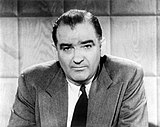
I am a child of the 60’s. Free love, LSD, civil rights movement, peace marches, student demonstrations on campus; all these were a part of my growing up. I did not participate in them, but they were part of the environment that I lived in. To comprehend the culture of the period, however, you have to understand the nature of the decade that came before that; you have to understand the climate of fear and repression that was the 1950’s-the time of post World War II America, the time of the rise of communism and the Iron Curtain, the time of Senator Joe McCarthy. http://en.wikipedia.org/wiki/Joseph_McCarthy

The one subject in history that can really stoke my angry fires, is McCarthyism. McCarthyism, in this context, refers not just to the events that surrounded Tail gunner Joe, but to the wave of mass paranoia that he rode like an expert surfer-and that others were surfing, too.

There were actually three events that were significant (in my way of thinking) that took place in the 1950’s that I find more frightening than anything except nuclear war itself. They were: 1) McCarthy's unconscionable anticommunist crusade, 2) the trial of William M. Gaines, publisher of Mad, but also the publisher of the EC comics line from which it sprang (including, in particular, the horror comics such as Tales From The Crypt, The Vault of Horror, The Haunt of Fear, etc.), and 3) the relentless persecution of Lenny Bruce by the justice department.

The figurehead for all of this, of course, was Senator Joe McCarthy, who duly deserves to be reviled for being the entirely uncouth and ruthless political opportunist that he was. McCarthy was an otherwise undistinguished Republican senator from Wisconsin, who, in 1950, claimed that he had a list of "members of the Communist Party and members of a spy ring" who were employed in the State Department. He later targeted the "Voice of America" radio broadcasts, and the United States Army (which proved to be his undoing). When he tried to tag President Truman as being soft on communism, Truman fired right back that "all that he had in that briefcase of his was a bottle of whiskey," which, as it turns out, was the absolute truth. But even if that wasn’t the case, the fact is that he recognized the postwar paranoia of the general population of the United States, and helped to focus it, as if he were sharpening a blade which he barely knew how to use, in a direction that, I suppose, he vaguely knew he wanted to cast it. And, like a young child with an Uzi in his hand, he created an environment of absolute fear which spread like a wildfire on the parched prairie of postwar America.

Where all this strikes home for me is this: I consider myself a 1st amendment absolutist. Freedom of speech is, to me, absolutely necessary in a democracy, even if the person that is speaking is tearing down the fabric of my society by doing so. I have to let him say it, because if I don't, then I can't say what I think. Plus, an absolutely unencumbered forum is necessary for the exchange of ideas. I can't learn something if the opportunity isn’t there for me to examine all resources existent freely, and neither can anyone else if I am muzzled.

And this is what McCarthy did; he targeted the entertainment industry, among other things, and opened fire on them.

The problem was that for the general population, there really was some cause for concern. In the great depression (when it became obvious that the enemies of the common people were rich fat-cat bankers and financiers), actors, directors, and playwrights banded together under a theater organization know as the Group Theater, which was a hotbed for social relevance as preached from the stage. Being that capitalism at the time was not working very well as a form of economic government, some of these artists (and also folk musicians) began to embrace socialism, and started to attend meetings of the communist party. And, quite naturally, their ideals flowed up onto the stage, and out into the audience. Although the Group Theater ceased in 1940, many of these artists and musicians came into national prominence via Broadway, Hollywood, and by way of the radio (and later TV) in your own home.

When the war in Europe ended, America (still smarting from the threat of a Nazi takeover of the world as we knew it) saw China, Hungary, Poland, etc. fall to Communism. The Iron Curtain was built. Russia developed the Nuclear Bomb. And suddenly, newly aware that the foundations of our democracy were shakier than we had originally presumed, our country was thrown into advanced stages of paranoia. McCarthy sensed this and rode this wave to national prominence. He drew his knives and went after the entertainment industry because the scariest thing about it was that it now came into our towns through the movies, and into our homes through the various forms of media that were available to us.

As far as I know, there was never any actual proof that the communist party ever intended to overthrow the United States government through the kind of brainwashing that McCarthyites figured that the entertainment industry was trying to do to the American public. The odd thing to me is that if the communist party wanted to do anything like that, all it really had to do was waive a red flag at the McCarthyites, and they would have destroyed democracy for them. Why? Because the McCarthyites were reactionaries, and as such they retreated into the very sort of mind-frame that they were actually afraid of: fascism!

As a result of this fascist thinking, the very frightened entertainment industry became polarized. On the one side were the MGMs, Paramounts, Disneys, and Goldwyns (the major studios and players in Hollywood at the time) who made it clear that they were true-blue Americans by drawing up the fabled Hollywood Blacklist which had, starting at the very top of the list, a group (standing on the other side) that became known as "the Hollywood 10"; including (among others) screenwriters and directors such as Herbert Biberman, Dalton Trumbo, Ring Lardner, Jr., and Albert Maltz; and went down from there to the common everyday clock punchers such as bit players and technicians. People who were on the blacklist couldn’t do their jobs; they either worked under pseudonyms (and in the case of writers, they hired a "front," a person who turned in their work under his own name), they quit their jobs altogether, or, at the very worst, committed suicide because they couldn’t make a living.

This, to me, is the very frightening face of fascism. There was the very famous moment on national TV during the Army-McCarthy hearings, when, after McCarthy had accused a young lawyer of communist affiliations, the attorney for the Army said to him, "Have you no sense of decency, sir? At long last, have you left no sense of decency?" What threat is one young lawyer to the government of the United States, which had survived the test of Civil War? What serious threat is an actor, a screenwriter, a director, whose only crime is one that is guaranteed as a constitutional right: that of expressing his views?

Once unleashed, though, this paranoia knew no bounds. Many movies and TV shows of the day can now be seen as veiled expressions of this fear: the movie Invasion of The Body Snatchers is a prime example of something that recognized this fear (i.e., made its money from it) and yet commented on it simultaneously (the aliens are taking over our minds and bodies-sort of like Communism!).

And we didn’t just fight it with a blacklist; we went after anything that disturbed our vision of a secure and happy way of life; in one particular case, we targeted profanity, using it as a blanket to cover what was really disturbing us: any social commentary that made us aware of what was really wrong in this country. I am referring to the legal harassment of Lenny Bruce.


I once did the play Lenny for a community theater, which tells the story of the wildly innovative comedian of the 1950s and 1960s, who used profanity quite frequently in routines that dwelt on current social issues (an unheard of idea at the time). Frankly, Lenny wasn’t my kind of comedian (I just don't find his material that funny); Bill Cosby is closer to the mark for me. But Lenny's influence is far-reaching: as Time magazine pointed out not too long ago, both the late George Carlin and Robert Klein owe a debt to Lenny, as did Richard Pryor. Interestingly enough, Cosby himself would have had a tough time if Lenny hadn’t gone there before him (although Bill's style is good clean family-oriented comedy, the fact that he is able to take a microphone and talk to you about it, owes a lot to Lenny's rants and raves).

But where I sympathize with Lenny is based solely on the 1st amendment to the United States Constitution; his right to say what he thought. A favorite story of mine that illustrates this is that they arrested him for profanity onstage one night. Released on bail he went back to work the next night. Stationed around the theater were cops ready to descend on him the first time he said any dirty word at all in front of the audience. He calmly grabbed the microphone and walked out the nearest exit onto the street, and proceeded to let loose with every single swear word that he could think of, because they couldn’t arrest him. He wasn’t saying them onstage!

But, if you listen to any of his monologues, you realize that his profanity was the least dangerous thing in his shtick. He was talking about poverty, racism, and war long before anyone else was. This was what really was offending people. The reality was that if he had just gotten on stage and just talked dirty, no one would have cared because there would have been no one to listen. Comedians like that come a dime a dozen and don't last one night on stage, even today. Chris Rock makes headlines with his profanity, but only-like Lenny-because, in between, he has something to say!

And so, because he spoke his mind, Lenny Bruce ended up dead on a toilet seat with a needle in his arm. http://en.wikipedia.org/wiki/Lenny_Bruce


But now our paranoia didn’t stop there: those commie bastards were destroying the minds of our children! The pop psychology of the fifties as expressed in books (predominately psychiatrist Dr. Frederic Wertham’s Seduction of the Innocent) and magazine articles was that the morals of our children were being destroyed by comic book artists. Because an artist had depicted a character wielding an axe, your boy was probably going to grow up to commit murder! The target for all of this paranoia was William M. Gaines, a young publisher who had taken a comic book company (Educational Comics-EC) which was losing money hand over fist, changed its direction (Entertaining Comics) and turned its business around with, as I said earlier, lurid titles like Tales From The Crypt, The Vault of Horror, The Haunt of Fear and one humor magazine, Mad. The onslaught that he suffered for those horror magazines broke his company (although he was finally absolved), and the effects were so far-reaching that DC Comics, Marvel Comics, and other companies set up the "Comics Code," an attempt to self censor themselves which ended up almost destroying the comic book industry creatively. Think, for a prime example, of a world without Batman, which DC, at the beginning of the '60’s was thinking of killing because sales were down (the TV show, and a subtle change of direction saved it).

Gaines lost everything, except one magazine; Mad. The sad punch line on all of this is that most of the fans of those magazines grew up to be contributing members of society: doctors, lawyers and, yes, even priests. No one swung an axe handle because he had seen it in a comic book. http://en.wikipedia.org/wiki/William_Gaines

The degree of hurt is what I am talking about. I don't have to love Lenny Bruce's humor, I don't have to like Tales of The Crypt, I don't have to hug a socialism spouting idiot as a brother! But if I don't let them have their say then they can't survive, and I can't have my say!

I suppose that why this riles me the most is because of what I went through in junior high school (middle school is the current equivalent). I was teased and sneered at because I was different than everyone else when I was growing up. It was being in the Drama group in high school that brought me out of myself; I realized that I had a forum where I could make people listen to what I had to say. And that saved my sanity.

So, the thought of stifling someone else angers me. I feel their pain. And the fact that Thomas Jefferson thought that it was an important enough freedom to place it first in the Bill of Rights, makes it all the more worth championing; because our founding fathers based our country and its government on this principle!