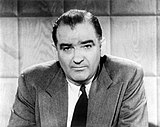
 I am a child of the 60’s. Free love, LSD, civil rights movement, peace marches, student demonstrations on campus; all these were a part of my growing up. I did not participate in them, but they were part of the environment that I lived in. To comprehend the culture of the period, however, you have to understand the nature of the decade that came before that; you have to understand the climate of fear and repression that was the 1950’s-the time of post World War II America, the time of the rise of communism and the Iron Curtain, the time of Senator Joe McCarthy. http://en.wikipedia.org/wiki/Joseph_McCarthy
The one subject in history that can really stoke my angry fires, is McCarthyism. McCarthyism, in this context, refers not just to the events that surrounded Tail gunner Joe, but to the wave of mass paranoia that he rode like an expert surfer-and that others were surfing, too.
There were actually three events that were significant (in my way of thinking) that took place in the 1950’s that I find more frightening than anything except nuclear war itself. They were: 1) McCarthy's unconscionable anticommunist crusade, 2) the trial of William M. Gaines, publisher of Mad, but also the publisher of the EC comics line from which it sprang (including, in particular, the horror comics such as Tales From The Crypt, The Vault of Horror, The Haunt of Fear, etc.), and 3) the relentless persecution of Lenny Bruce by the justice department.
The figurehead for all of this, of course, was Senator Joe McCarthy, who duly deserves to be reviled for being the entirely uncouth and ruthless political opportunist that he was. McCarthy was an otherwise undistinguished Republican senator from Wisconsin, who, in 1950, claimed that he had a list of "members of the Communist Party and members of a spy ring" who were employed in the State Department. He later targeted the "Voice of America" radio broadcasts, and the United States Army (which proved to be his undoing). When he tried to tag President Truman as being soft on communism, Truman fired right back that "all that he had in that briefcase of his was a bottle of whiskey," which, as it turns out, was the absolute truth. But even if that wasn’t the case, the fact is that he recognized the postwar paranoia of the general population of the United States, and helped to focus it, as if he were sharpening a blade which he barely knew how to use, in a direction that, I suppose, he vaguely knew he wanted to cast it. And, like a young child with an Uzi in his hand, he created an environment of absolute fear which spread like a wildfire on the parched prairie of postwar America.
Where all this strikes home for me is this: I consider myself a 1st amendment absolutist. Freedom of speech is, to me, absolutely necessary in a democracy, even if the person that is speaking is tearing down the fabric of my society by doing so. I have to let him say it, because if I don't, then I can't say what I think. Plus, an absolutely unencumbered forum is necessary for the exchange of ideas. I can't learn something if the opportunity isn’t there for me to examine all resources existent freely, and neither can anyone else if I am muzzled.
And this is what McCarthy did; he targeted the entertainment industry, among other things, and opened fire on them.
The problem was that for the general population, there really was some cause for concern. In the great depression (when it became obvious that the enemies of the common people were rich fat-cat bankers and financiers), actors, directors, and playwrights banded together under a theater organization know as the Group Theater, which was a hotbed for social relevance as preached from the stage. Being that capitalism at the time was not working very well as a form of economic government, some of these artists (and also folk musicians) began to embrace socialism, and started to attend meetings of the communist party. And, quite naturally, their ideals flowed up onto the stage, and out into the audience. Although the Group Theater ceased in 1940, many of these artists and musicians came into national prominence via Broadway, Hollywood, and by way of the radio (and later TV) in your own home.
When the war in Europe ended, America (still smarting from the threat of a Nazi takeover of the world as we knew it) saw China, Hungary, Poland, etc. fall to Communism. The Iron Curtain was built. Russia developed the Nuclear Bomb. And suddenly, newly aware that the foundations of our democracy were shakier than we had originally presumed, our country was thrown into advanced stages of paranoia. McCarthy sensed this and rode this wave to national prominence. He drew his knives and went after the entertainment industry because the scariest thing about it was that it now came into our towns through the movies, and into our homes through the various forms of media that were available to us.
As far as I know, there was never any actual proof that the communist party ever intended to overthrow the United States government through the kind of brainwashing that McCarthyites figured that the entertainment industry was trying to do to the American public. The odd thing to me is that if the communist party wanted to do anything like that, all it really had to do was waive a red flag at the McCarthyites, and they would have destroyed democracy for them. Why? Because the McCarthyites were reactionaries, and as such they retreated into the very sort of mind-frame that they were actually afraid of: fascism!
As a result of this fascist thinking, the very frightened entertainment industry became polarized. On the one side were the MGMs, Paramounts, Disneys, and Goldwyns (the major studios and players in Hollywood at the time) who made it clear that they were true-blue Americans by drawing up the fabled Hollywood Blacklist which had, starting at the very top of the list, a group (standing on the other side) that became known as "the Hollywood 10"; including (among others) screenwriters and directors such as Herbert Biberman, Dalton Trumbo, Ring Lardner, Jr., and Albert Maltz; and went down from there to the common everyday clock punchers such as bit players and technicians. People who were on the blacklist couldn’t do their jobs; they either worked under pseudonyms (and in the case of writers, they hired a "front," a person who turned in their work under his own name), they quit their jobs altogether, or, at the very worst, committed suicide because they couldn’t make a living.
This, to me, is the very frightening face of fascism. There was the very famous moment on national TV during the Army-McCarthy hearings, when, after McCarthy had accused a young lawyer of communist affiliations, the attorney for the Army said to him, "Have you no sense of decency, sir? At long last, have you left no sense of decency?" What threat is one young lawyer to the government of the United States, which had survived the test of Civil War? What serious threat is an actor, a screenwriter, a director, whose only crime is one that is guaranteed as a constitutional right: that of expressing his views?
Once unleashed, though, this paranoia knew no bounds. Many movies and TV shows of the day can now be seen as veiled expressions of this fear: the movie Invasion of The Body Snatchers is a prime example of something that recognized this fear (i.e., made its money from it) and yet commented on it simultaneously (the aliens are taking over our minds and bodies-sort of like Communism!).
And we didn’t just fight it with a blacklist; we went after anything that disturbed our vision of a secure and happy way of life; in one particular case, we targeted profanity, using it as a blanket to cover what was really disturbing us: any social commentary that made us aware of what was really wrong in this country. I am referring to the legal harassment of Lenny Bruce.
 I once did the play Lenny for a community theater, which tells the story of the wildly innovative comedian of the 1950s and 1960s, who used profanity quite frequently in routines that dwelt on current social issues (an unheard of idea at the time). Frankly, Lenny wasn’t my kind of comedian (I just don't find his material that funny); Bill Cosby is closer to the mark for me. But Lenny's influence is far-reaching: as Time magazine pointed out not too long ago, both the late George Carlin and Robert Klein owe a debt to Lenny, as did Richard Pryor. Interestingly enough, Cosby himself would have had a tough time if Lenny hadn’t gone there before him (although Bill's style is good clean family-oriented comedy, the fact that he is able to take a microphone and talk to you about it, owes a lot to Lenny's rants and raves).
But where I sympathize with Lenny is based solely on the 1st amendment to the United States Constitution; his right to say what he thought. A favorite story of mine that illustrates this is that they arrested him for profanity onstage one night. Released on bail he went back to work the next night. Stationed around the theater were cops ready to descend on him the first time he said any dirty word at all in front of the audience. He calmly grabbed the microphone and walked out the nearest exit onto the street, and proceeded to let loose with every single swear word that he could think of, because they couldn’t arrest him. He wasn’t saying them onstage!
But, if you listen to any of his monologues, you realize that his profanity was the least dangerous thing in his shtick. He was talking about poverty, racism, and war long before anyone else was. This was what really was offending people. The reality was that if he had just gotten on stage and just talked dirty, no one would have cared because there would have been no one to listen. Comedians like that come a dime a dozen and don't last one night on stage, even today. Chris Rock makes headlines with his profanity, but only-like Lenny-because, in between, he has something to say!
And so, because he spoke his mind, Lenny Bruce ended up dead on a toilet seat with a needle in his arm. http://en.wikipedia.org/wiki/Lenny_Bruce
 But now our paranoia didn’t stop there: those commie bastards were destroying the minds of our children! The pop psychology of the fifties as expressed in books (predominately psychiatrist Dr. Frederic Wertham’s Seduction of the Innocent) and magazine articles was that the morals of our children were being destroyed by comic book artists. Because an artist had depicted a character wielding an axe, your boy was probably going to grow up to commit murder! The target for all of this paranoia was William M. Gaines, a young publisher who had taken a comic book company (Educational Comics-EC) which was losing money hand over fist, changed its direction (Entertaining Comics) and turned its business around with, as I said earlier, lurid titles like Tales From The Crypt, The Vault of Horror, The Haunt of Fear and one humor magazine, Mad. The onslaught that he suffered for those horror magazines broke his company (although he was finally absolved), and the effects were so far-reaching that DC Comics, Marvel Comics, and other companies set up the "Comics Code," an attempt to self censor themselves which ended up almost destroying the comic book industry creatively. Think, for a prime example, of a world without Batman, which DC, at the beginning of the '60’s was thinking of killing because sales were down (the TV show, and a subtle change of direction saved it).
Gaines lost everything, except one magazine; Mad. The sad punch line on all of this is that most of the fans of those magazines grew up to be contributing members of society: doctors, lawyers and, yes, even priests. No one swung an axe handle because he had seen it in a comic book. http://en.wikipedia.org/wiki/William_Gaines
The degree of hurt is what I am talking about. I don't have to love Lenny Bruce's humor, I don't have to like Tales of The Crypt, I don't have to hug a socialism spouting idiot as a brother! But if I don't let them have their say then they can't survive, and I can't have my say!
I suppose that why this riles me the most is because of what I went through in junior high school (middle school is the current equivalent). I was teased and sneered at because I was different than everyone else when I was growing up. It was being in the Drama group in high school that brought me out of myself; I realized that I had a forum where I could make people listen to what I had to say. And that saved my sanity.
So, the thought of stifling someone else angers me. I feel their pain. And the fact that Thomas Jefferson thought that it was an important enough freedom to place it first in the Bill of Rights, makes it all the more worth championing; because our founding fathers based our country and its government on this principle!


 Posts
Posts


No comments:
Post a Comment